Water
How many people do you know that are willing to drink their municipal tap water any more? This is something pretty basic... is the water that comes out of your tap safe to drink? Why is that? Could it be because of pollution? Here's an interesting tidbit from Wikipedia:
In 2004, Andrea Petersen wrote in the Wall Street Journal that "... for the first time, Americans are expected to buy more bottled water than beer or coffee. Sales of bottled water reached $7.7 billion in 2002, up 12% from 2001, according to Beverage Marketing Corp., a New York-based consulting company.”
$7.7 billion because people don't think their tap water is safe to drink. Of course that same article also says that "About 25% of bottled water sold is simply re-processed/used municipal(city) water according to a 1999 study in the United States" so it's not like the bottled water is that much safer anyway.
Air
So what about the air? Screw "Greenhouse Gases", let's talk about all the other crap we put in the atmosphere... Here's another tidbit from Wikipedia:
The World Health Organization states that 2.4 million people die each year from causes directly attributable to air pollution; with 1.5 million of these deaths attributable to indoor air pollution. A study by the University of Birmingham has shown a strong correlation between pneumonia related deaths and air pollution from motor vehicles. Worldwide more deaths per year are linked to air pollution than to automobile accidents. Published in 2005 suggests that 310,000 Europeans die from air pollution annually. Direct causes of air pollution related deaths include aggravated asthma, bronchitis, emphysema, lung and heart diseases, and respiratory allergies. The US EPA estimates that a proposed set of changes in diesel engine technology (Tier 2) could result in 12,000 fewer premature mortalities, 15,000 fewer heart attacks, 6,000 fewer emergency room visits by children with asthma, and 8,900 fewer respiratory-related hospital admissions each year in the United States.
I really have to believe that the healthcare costs associated with all of that are likely to be a pretty significant number of their own and that's not even dealing with the human costs. What the heck has happened that we have to have air quality reports as part of the weather report? And what will we do if or when air quality deteriorates enough? Start buying bottled air too? As I'm writing this, 4 U.S. cities have air quality low enough that it's "unhealthy" to breathe and that's with air quality levels that are actually pretty good today compared to most summer days so maybe I should find a nice bottled air company to invest in.
Oil
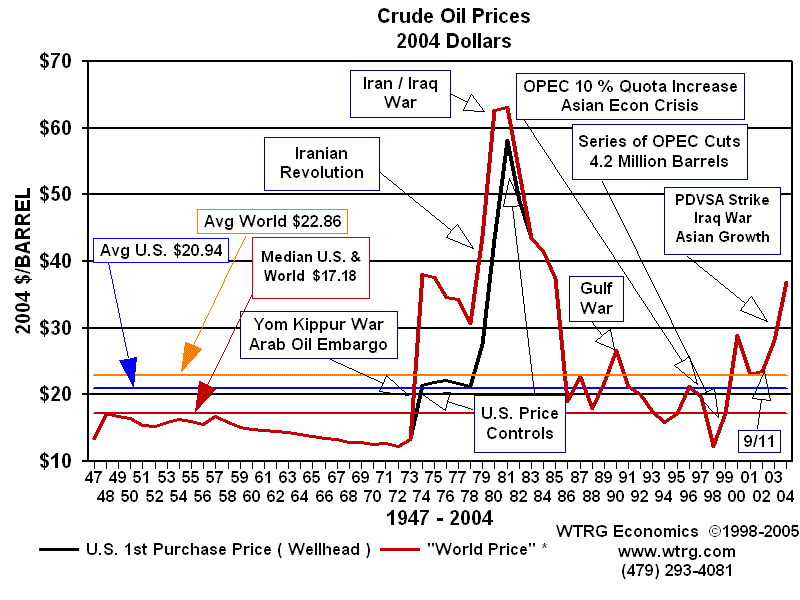
And then there's oil. In 2001 the price of a barrel of oil was roughly $25. In the last few weeks it has been bouncing around $140 per barrel. And here's a nice little chart for those of you that like pictures. Similarly in 2001 the price of a gallon of gasoline was around $1.25 and seven years later we're paying over $4.00 a gallon and wondering if it will break $5.00 before the summer is done. Here's another pretty chart for the picturephiles out there. The Department of Energy says that we consumed 20.7 million barrels of oil on average per day during 2006. Now if we figure the cost in 2001 vs. the cost today for that 20.7 million barrels of oil per day, we see that it's costing us almost $2.4 billion a day in increased costs. That's right about $869 billion dollars a year or right around 10% of the entire national debt.
Isn't that right there enough reason to consider fuel efficiency standards? Forget Global Warming, look at what that's doing to the strength of the Dollar, the cost of every damn thing because of shipping costs, the balance of our trade, and the overall health of our economy with just short of an extra trillion dollars a year being spent.
Global Warming doesn't matter
At this point it should be pretty obvious that whichever side of the Global Warming debate you're on, there's some damn good reasons why we need to change. When people say it will cost too much to change, I just wonder how we can afford not to. At this rate, we'll have water we can't drink, air we can't breathe, and cars we can't afford to drive which will have it's own economic impact and it will be considerably larger than the adjustment to consume and pollute less than we are.

No comments:
Post a Comment